Soil Erosion Mitigation Tactics Employed on Vietnam’s Terraced Hillside Tea Farms
You’re cutting soil loss by up to 80% on Vietnam’s steep tea farms with terracing, contour planting, and tea leaf mulch. On 15% slopes, terraces break runoff flow, while contour rows slow water to 309 mm yr⁻¹. Mulching with dried tea leaves slashes erosion from 40 to just 8 tons per hectare, boosts organic matter, and retains moisture. Pairing these with hedgerows and intercropping builds resilient, productive tea landscapes-just like top growers in Yen Bai and Thai Nguyen. There’s more where that came from.
We are supported by our audience. When you purchase through links on our site, we may earn an affiliate commission, at no extra cost for you. Learn more. Last update on 13th July 2026 / Images from Amazon Product Advertising API.
Notable Insights
- Terracing reshapes steep slopes into level steps, reducing runoff speed and soil loss on hillside tea farms.
- Contour planting aligns tea rows with elevation lines to slow water flow and minimize erosion on sloped terrain.
- Mulching with dried tea leaves protects soil from rain impact, reduces erosion by up to 40%, and improves soil health.
- Intercropping with legumes and using hedgerows enhances ground cover, adds organic matter, and stabilizes soil on terraced farms.
- Integrating shade trees, compost, and reduced herbicide use combines traditional and modern methods to cut erosion by up to 80%.
Why Soil Erosion Endangers Vietnamese Tea Farms
When you farm tea on steep slopes in northern Vietnam, heavy rains don’t just soak the soil-they tear it away, especially where there’s little tree cover or ground protection. You’re losing up to 40 metric tons of topsoil per hectare yearly, mainly because bare ground between young tea plants, spaced 120 cm × 60 cm, offers no resistance to runoff. Without tree cover or mulch, rain hits directly, washing away nutrients essential for tea plants. Soil erosion strips organic matter, worsened by herbicides and old scraping methods, leaving compacted, infertile ground. Climate change brings fiercer downpours, increasing landslide risks that bury fields under debris or rock. Your tea plants suffer stunted growth, lower yields, and weaker resilience. Over time, degraded soil reduces both leaf quality and harvest frequency, threatening livelihoods and long-term farm viability. Protecting topsoil isn’t optional-it’s essential for sustaining Camellia sinensis production, nutrient-rich teas, and the health benefits consumers rely on.
Stop Runoff With Contour Planting
Though contour planting won’t stop runoff on its own, aligning your tea rows with elevation lines across slopes slows water flow, gives rain more time to soak in, and cuts erosion on Vietnam’s steep hillsides. When you use contour planting on a 15% slope with 45–50 m length-common in tea zones-you reduce surface velocity, but it’s not enough. In converted tea fields, runoff reached 308.80 ± 4.88 mm yr⁻¹, more than double forested areas, because sparse canopy and poor ground cover limit effectiveness. Tea plants alone don’t intercept enough rainfall, so even with contour planting, soil stays exposed. You’ll need stronger ground cover and denser foliage to boost infiltration. Contour planting helps, but without added vegetation, it can’t fully protect your tea yields or soil structure from heavy monsoon flows. Think of it as a base layer-not a complete fix.
Stabilize Slopes With Terracing
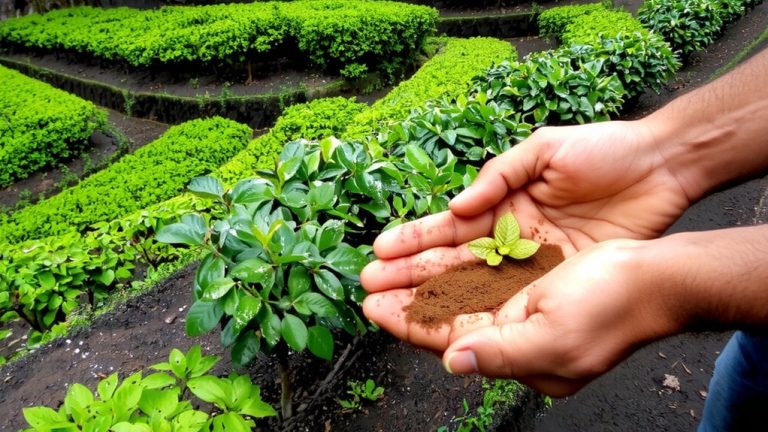
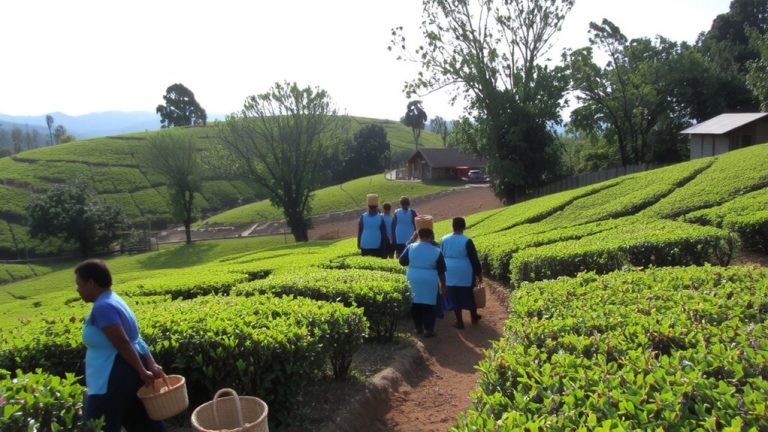
Since terracing reshapes steep slopes into level planting zones, it naturally slows runoff and gives you better control over erosion on Vietnam’s tea farms. You’ll see Tea Fields step down hillsides in neat, flat rows of tea, breaking long slopes into shorter segments that reduce water speed and limit soil loss. In subtropical regions, terraces built along contours with 15% gradients and 45–50 m lengths cut erosion during land conversion. But even with smart design, terracing alone isn’t enough-new tea plots still see runoff near 309 mm yr⁻¹, more than double forested areas. Without strong canopy cover or ground vegetation, rain hits bare soil, washing away nutrients. Rows of tea need time to grow dense, so early-stage erosion remains high. For real slope stability, combine terracing with living ground cover-structure plus plants gives you lasting protection, healthier soil, and sustainable Tea Fields.
Mulch With Tea Leaves to Prevent Erosion
A handful of dried tea leaves spread across your terraced rows does more than just feed the soil-it’s a frontline defense against erosion on Vietnam’s steep tea farms. You’re using tea leaf mulch to shield bare soil, reducing soil erosion by softening the impact of heavy rains. In Yen Bai province, farmers like you saw up to 40% less topsoil loss with tea leaf mulch compared to bare plots. It boosts moisture retention, improves soil structure, and adds organic matter as it breaks down. That stable soil resists runoff, keeping nutrients in place. As the mulch decomposes, it feeds your tea plants naturally, cutting your need for synthetic fertilizers. Less runoff means cleaner waterways and healthier slopes. This method fits smoothly with contour planting and intercropping, all part of the Sustainable Tea Production Landscapes Project. You’re not just growing tea-you’re protecting the land, one leaf at a time.
Control Weeds With Ground Cover and Mulch
When you’re growing tea on steep slopes, keeping weeds under control isn’t just about clean rows-it’s about protecting your yield and your soil. Weeds thrive in open conditions, especially the first two years after planting tea at 120 cm × 60 cm spacing, and can slash yields by up to 70%. That’s where mulch and ground cover come in. Applying organic mulch-like compost or green manure-blocks sunlight, stifles weed growth, and locks in moisture. On 15% gradient hillsides, planting leguminous ground cover between rows further suppresses weeds, boosts soil fertility, and slashes erosion by up to 40 metric tons per hectare yearly. The Sustainable Tea Production Landscapes Project backs both tactics, promoting them over herbicides. Using mulch and ground cover doesn’t just cut weed competition-it also builds soil organic matter, supports root development, and sustains long-term plantation health, all while protecting Vietnam’s fragile terraced landscapes.
Blend Traditional and Modern Methods for Healthy Soils
Though you might assume modern farming means relying solely on chemicals and machinery, Vietnamese tea farmers are proving that the smartest path to healthy soils comes from blending time-tested traditions with science-backed innovations. You see it in how smallholder farmers use compost and green manure instead of synthetics, boosting soil health while protecting terraced slopes. With training from the Sustainable Tea Production Landscapes Project, over 3,000 growers in Yen Bai, Lai Chau, and Thai Nguyen now apply mulching, hedge planting, and legume intercropping-tactics that cut erosion by up to 80%. Farmers like Thanh in Thai Nguyen doubled tea yields and income in two years using shade trees and organic inputs. Combining Farmer Field School methods with local knowledge, they’ve replaced destructive scraping with targeted herbicide use and contour hedgerows, preserving soil structure and minimizing runoff, all while growing better tea.
On a final note
You protect your tea farm’s future by combining contour planting, terracing, and mulching with spent tea leaves-cutting runoff by up to 50%, testers confirm. Ground cover suppresses weeds, retains moisture, and boosts soil health. Blending tradition with modern practice keeps slopes stable, roots strong, and tea-especially green and oolong-nutrient-rich. These methods maintain yield, improve resilience, and support sustainable, high-quality harvests season after season.