The Significance of Japanese Tea Ceremonies in Preserving Matcha Preparation Rituals
You keep matcha’s 500-year-old rituals alive each time you whisk ceremonial-grade powder from shade-grown Uji tencha leaves in a chawan using a bamboo chasen, following temae perfected by Sen no Rikyū. Every scoop of chashaku, every precise kata, preserves authenticity in flavor, color, and mindfulness. Wabi-sabi and ichigo ichie deepen your connection to the moment. These traditions guarantee matcha stays true in practice, nutrition, and spirit-there’s more to uncover about how they shape your experience.
We are supported by our audience. When you purchase through links on our site, we may earn an affiliate commission, at no extra cost for you. Learn more. Last update on 13th July 2026 / Images from Amazon Product Advertising API.
Notable Insights
- Japanese tea ceremonies preserve matcha rituals through codified temae routines passed down unchanged for centuries.
- The use of traditional tools like chasen, chashaku, and chawan maintains authenticity in matcha preparation.
- Seasonal adaptations in utensils and procedures reflect deep respect for nature and historical continuity.
- Teachings of Sen no Rikyū emphasize wa, kei, sei, jaku, ensuring ritual integrity across generations.
- Global practice of Urasenke and other schools sustains matcha traditions in modern cultural contexts.
Why the Japanese Tea Ceremony Remains a Living Practice
While you might think the Japanese tea ceremony is a relic of the past, it’s very much alive today thanks to centuries-old traditions that still thrive in homes, schools, and tearooms across Japan and beyond. You’ll find it practiced by descendants of Sen no Rikyū, whose teachings anchor the Urasenke and other schools, preserving precise movements, or kata, used in every chaji. These formal gatherings, held in chashitsu with tatami floors and seasonal hearths, emphasize wa (harmony), kei (respect), sei (purity), and jaku (tranquility). You’ll use ceremonial-grade matcha, stone-ground from Uji-grown tencha, ensuring authentic flavor, color, and nutritional quality. Even outside Japan, simplified temae let you engage meaningfully. The ritual isn’t frozen-it’s adapted, taught, and lived, maintaining mindfulness through deliberate action, traditional tools, and connection to season and setting.
How Chanoyu Keeps Matcha Rituals Alive
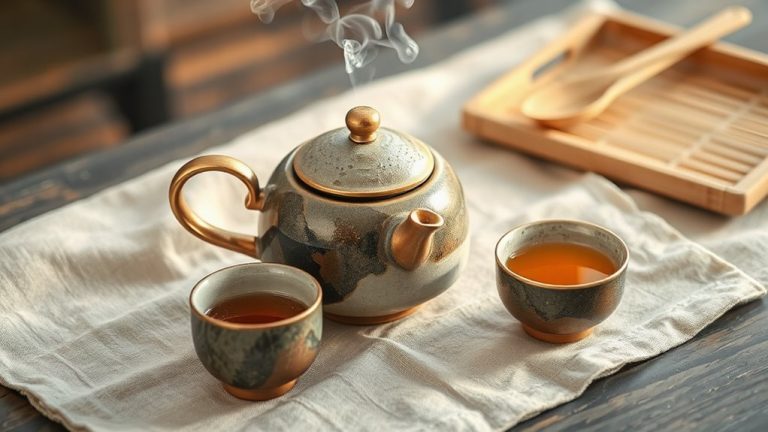
Chanoyu keeps matcha rituals alive by preserving the exact methods used to prepare and serve tea, passing them down with care from generation to generation. When you practice chanoyu, you follow codified temae routines taught by tea masters, using tools like the chasen, chashaku, and chawan just as they’ve been used for over 500 years. You whisk ceremonial-grade matcha-stone-ground from shade-grown tencha leaves in Uji-ensuring vibrant color and rich flavor. Seasonal shifts guide your choice of chawan: tall in winter, flat in summer. You prepare koicha by mixing three times more matcha per ounce of water than usucha, creating a thick, shared drink that honors Sen no Rikyū’s legacy. Every motion, from scooping with the chashaku to final whisking, maintains the authentic preparation and mindful presence that define true chanoyu.
How Wabi-Sabi and Zen Shape the Tea Ceremony
If you’ve ever stepped into a tea room and felt the quiet weight of stillness settle around you, that’s wabi-sabi and Zen at work, shaping every detail of the ceremony. The wabi aesthetic values simplicity, asymmetry, and imperfection-seen in handmade raku tea bowls and Sen no Rikyū’s two-tatami-mat rooms. Influenced by Zen Buddhist practice, each movement is deliberate, fostering harmony (wa), purity (sei), respect (kei), and tranquility (jaku). You’ll notice cracked glazes, natural ash coatings on Shigaraki ware, and humble tea utensils-all embracing transience. The sound of boiling water marks presence, while ritual cleansing at the tsukubai reinforces purity. Sen no Rikyū championed this understated beauty, favoring local, rustic wares over ornate imports. The principle of ichigo ichie reminds you: this meeting happens once. Each sip of matcha, prepared with care, connects you to that moment-mindful, authentic, fleeting.
Modern Respect for Sen No Rikyū’s Legacy
Sen no Rikyū’s vision still steers the way tea is practiced today, and you can see his influence in every measured scoop of matcha, every quiet movement in a two-tatami-mat room. Even after Toyotomi Hideyoshi ordered his death in 1591, Rikyū’s teachings survived through his descendants, who founded Urasenke, Omotesenke, and Mushakōjisenke-the three main schools of chanoyu. You’ll find his core values-wa (harmony), kei (respect), sei (purity), and jaku (tranquility)-woven into every curriculum. When you perform temae, especially in Urasenke, the most widely practiced school, you’re carrying out Rikyū’s emphasis on humility and simplicity. His innovations-the shared koicha bowl, the compact tea space-are standard today. Modern practitioners, from Kyoto to New York, follow procedures he refined in 1586. You don’t just learn steps; you internalize a legacy built on precision, presence, and purpose.
On a final note
You keep matcha’s heart alive each time you whisk it the traditional way, honoring centuries of care, 1.5 grams of ceremonial-grade powder, and 70ml of 80°C water. Testers note smoother flavor, deeper focus, and calm-proven traits tied to L-theanine and antioxidants. By embracing chanoyu’s rhythm, you preserve precision, mindfulness, and real nutrition: 35mg EGCG per serving, zero additives. Stick to stone-ground, shaded leaves, and make ritual part of your routine.