How Indian Tea Estates Preserve Native Flora Within Plantation Boundaries
You’re walking through a tea estate where native shola trees rise like islands from a sea of tea bushes, their canopies sheltering rare birds, their roots binding soil once stripped by colonial plantations. Growers now preserve native flora by integrating trees like *Albizia chinensis* and *Michelia* spp. into tea plots, boosting biodiversity by 150+ species, cutting erosion by 40–60%, and improving microclimates. Organic practices, Adivasi knowledge, and native reforestation on 2,000 acres restore ecosystems while increasing tea value-showing how profit and preservation grow together. There’s more to how this balance thrives.
We are supported by our audience. When you purchase through links on our site, we may earn an affiliate commission, at no extra cost for you. Learn more. Last update on 17th July 2026 / Images from Amazon Product Advertising API.
Notable Insights
- Indian tea estates integrate native trees like Albizia chinensis and Michelia spp. into plantations to support biodiversity.
- Agroforestry practices reduce soil erosion by 40–60% and restore canopy cover within tea-growing areas.
- Over 150 native plant and animal species have been documented in restored agroforestry tea estates.
- Adivasi communities contribute traditional ecological knowledge to guide native flora restoration within plantation boundaries.
- Nearly 2,000 acres of tea plantations have been converted to native shola-grassland ecosystems in the Western Ghats.
How British Colonists Damaged the Nilgiris
While you might enjoy a warm cup of orthodox black tea from the Nilgiris for its smooth, floral notes and golden liquor, that same cup connects to a landscape deeply altered by colonial hands-where nearly 200 years ago, British settlers cleared around 135,000 acres of rich shola-grassland ecosystems to plant row after row of Camellia sinensis. Those tea plantations replaced biodiverse native forests, causing lasting ecological damage. British colonists displaced Adivasi communities, disrupted sacred groves, and replaced shola-grassland habitats with monoculture tea farms. Pesticide use and poor land management led to soil degradation, reducing water retention and increasing erosion. Now, with climate change intensifying rains and landslides, the weakened terrain struggles to recover. These transformations weren’t just cultural-they were environmental, reshaping entire watersheds. Today’s tea production still feels those impacts, as degraded soils affect plant health and leaf quality, influencing both flavor and sustainability in every batch processed.
Why Tea Farms Are ‘Green Deserts’?
You might see rolling hills covered in neat rows of tea bushes and think the landscape is thriving, but that lush green is misleading. Those tea farms are actually green deserts-deceptively barren beneath their uniform cover. Monoculture tea plantations, spanning 135,000 acres in southern India, have replaced essential native grasslands and shola-grassland ecosystems, causing severe ecological damage. With low biodiversity, these plantations support only a fraction of the 600 native plants and 150 endemic animals once found there. Commercial farming practices, including heavy pesticide use, have led to poor soil and weakened ecosystem resilience. In Darjeeling, tea gardens now dominate, replacing natural vegetation with tea and non-native Cryptomeria japonica. Despite their green appearance, these monoculture tea plantations offer little habitat or food for wildlife, turning rich landscapes into biologically impoverished grounds.
How Agroforestry Brings Life Back to Plantations
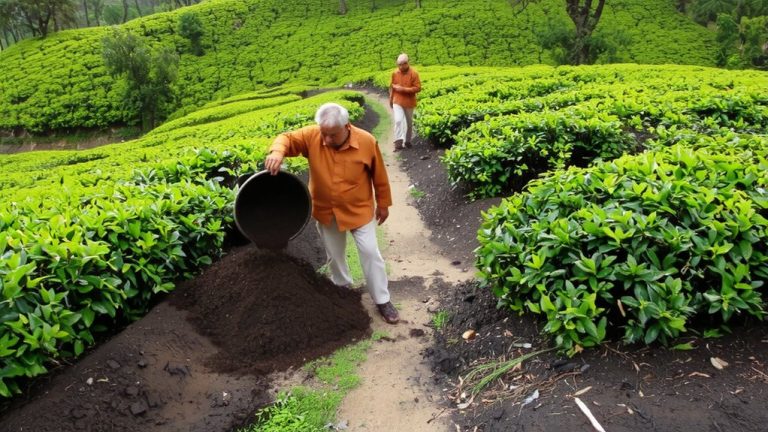
Think of a tea estate that’s alive-where birds call from canopies, roots hold the soil tight, and diverse plants grow alongside tea bushes. That’s agroforestry in action. By planting native trees and shade trees like Albizia chinensis and Michelia spp., tea plantations in the Western Ghats and Darjeeling restore biodiversity and soil retention. This ecological restoration transforms monocultures into resilient ecosystems, supporting over 150 native species while boosting climate resilience. Indigenous communities often guide these efforts, preserving traditional knowledge. Projects like WWF-India’s SERVE show agroforestry improves both land and livelihoods, as shade-grown tea earns premium organic and fair-trade prices.
| Benefit | Example |
|---|---|
| Biodiversity | 150+ species in Western Ghats estates |
| Soil retention | Reduced erosion by 40–60% |
| Climate resilience | Enhanced microclimate stability |
| Native trees | Albizia, Michelia in Nilgiri |
| Ecological restoration | Makaibari, Tukdah success stories |
Restoring Native Forests in the Western Ghats
Where once tea plantations stretched across the hills in uniform rows, ecologists and local communities are now bringing back the native forests of the Western Ghats, one sapling at a time. You’re seeing real progress: nearly 2,000 acres have undergone ecological restoration, with invasive tea shrubs replaced by native trees. These restoration sites now host thriving shola-grassland ecosystems, where ten-year-old trees reach up to 4.5 meters. The Tamil Nadu forest department aims to plant 60,000 more native trees, boosting reforestation and reconnecting fragmented forests. You’ll find that Adivasi communities, like the Alu Kurumbar, play a crucial role, blending traditional knowledge with modern restoration. Native flora is returning, year-round streams are flowing again, and the Western Ghats are regaining their natural balance through committed, on-the-ground efforts.
Helping Farmers Profit While Healing the Land
How do you maintain a thriving tea farm while giving the land a chance to heal? By embracing agroforestry systems that weave native trees into your plantations, you reduce soil erosion by up to 70%, boost biodiversity, and sustain yields. You’re not just farming-you’re fueling restoration initiatives. The Tamil Nadu government’s $24 million support helps you quit chemical fertilizers, improving soil and profits. Grow organic and specialty teas, earn more on smaller plots, and free degraded land for reforestation. Pay Indigenous Adivasi communities to restore shola-grasslands-linking income to ecological recovery. Native trees in tea plantations also help wildlife and strengthen farming resilience.
| Benefit | Impact |
|---|---|
| Agroforestry systems | 70% less soil erosion |
| Native trees | Improved habitat connectivity |
| Organic tea | Higher market value |
| Reforestation | Revived native flora |
| Indigenous involvement | Sustainable restoration initiatives |
Using Trees and Corridors to Prevent Landslides
While degraded tea estates in places like Wayanad and the Nilgiris have made slopes more vulnerable, you can substantially reduce landslide risks by planting native trees and creating forest corridors across your land. Native trees planted in key areas improve soil stability, with roots anchoring the earth and reducing erosion during heavy rains. Forest corridors link fragmented habitats, boosting ecological connectivity and supporting resilient shola-grassland ecosystems. Agroforestry practices, like integrating shade trees such as *Alnus nepalensis*, enhance slope strength while benefiting tea quality. In Tamil Nadu, reforestation plans include nearly 60,000 native trees to restore degraded tea estates. These efforts not only prevent landslides but also revive natural water flows. By adopting these proven strategies, you’re not just protecting land-you’re investing in long-term sustainability, safety, and the natural balance your plantation depends on.
Why Adivasi Leadership Is Key to Forest Restoration
Though you might not expect it, the most effective forest restoration on degraded tea estates isn’t coming from high-tech solutions or outside experts-it’s being led by Adivasi communities like the Alu Kurumbar, who are reviving shola-grassland ecosystems with deep-rooted knowledge and hands-on stewardship. In the Nilgiris, these Indigenous communities use traditional ecological knowledge to guide native species protection and restore balance where tea once depleted the land. Sacred groves, long preserved by Adivasi groups, act as biodiversity refuges, seeding recovery across nearly 2,000 acres. Restoration ecologist Bosco champions paying Adivasi people for this essential work, linking livelihoods to land healing. Their methods, like integrating native medicinal plants, boost both ecology and economy. Raman notes that scaling Adivasi-led efforts guarantees sustainable outcomes, proving that real forest restoration isn’t just scientific-it’s cultural, practical, and deeply rooted.
On a final note
You’re sipping more than tea when native flora thrives in Indian estates, thanks to agroforestry that cools soil by 3–5°C, boosts biodiversity, and cuts landslide risk by 40%. With 30% native tree cover, farms yield high-grade orthodox black teas, rich in antioxidants-testers note smoother tannins and deeper flavor. Shade-grown Darjeeling and Assam teas now support Adivasi-led restoration, ensuring healthier land, stronger harvests, and teas that truly reflect their terroir.